
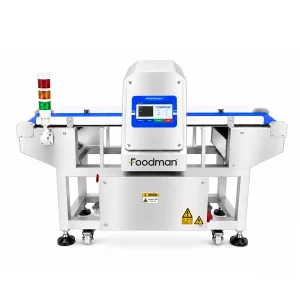
Metal contamination can arise long before finished food reaches a package. Raw ingredients may carry unwanted particles. Cutting, mixing, conveying, and packing equipment can introduce fragments through wear or accidental damage. Different foods present different inspection conditions. Food Industry Metal Detectors have become relevant across several manufacturing environments. They are not limited to one production category. Automated food inspection offers a wider perspective. Metal detection can form part of a structured approach to physical-contamination control. Easyweigh illustrates this.
Meat and Seafood Processing
Meat processing involves extensive contact with knives, grinders, cutters, and other mechanical components. Continuous movement and repeated contact between equipment parts can create opportunities for ferrous, non-ferrous, or stainless-steel fragments to enter the product stream. Inspection becomes particularly relevant after mechanical processing, where contamination may no longer be visible on the product surface.
Seafood presents its own inspection considerations. Fish fillets, shellfish, and processed seafood can contain irregular shapes and naturally occurring hard materials, while processing machinery introduces additional physical risks. Product temperature, moisture, and density may also influence inspection conditions, making production-specific testing valuable.
Placement should correspond with the process rather than follow a fixed formula. Inspection after grinding, portioning, or forming may address risks associated with mechanical handling, while another checkpoint closer to packaging can provide an additional review of finished goods.
Bakery and Snack Production
Flour, grains, seeds, nuts, and other bakery ingredients pass through multiple handling stages before becoming finished products. Agricultural materials can carry foreign particles from harvesting or transportation, while mixers, rollers, cutters, and conveyors create separate mechanical risks during manufacturing.
Snacks bring another combination of factors. Nuts, chips, crackers, and confectionery products can differ substantially in size, density, moisture, and formulation. Such variation affects how inspection should be validated, particularly when several products share one processing route.
Packaging does not remove the need for physical-contamination controls. Products may encounter additional machinery during filling, sealing, or conveying, so inspection placement should reflect the points at which new contamination could occur. Food Industry Metal Detectors can therefore serve different functions depending on whether the target is ingredient-related or associated with later processing.
Dairy and Prepared Foods
Dairy production covers products ranging from cheese and processed dairy items to packaged foods containing dairy ingredients. Cutting, slicing, mixing, and portioning equipment can create mechanical contamination risks, while product composition may vary considerably between recipes.
Prepared foods add even greater diversity. Dumplings, sauces, ready meals, meatballs, and mixed dishes can contain several ingredients with different physical properties. Moisture and conductivity may influence detector response, so validation should account for the actual recipe rather than treating every product in the same manner.
Package format deserves consideration as well. Pouches, trays, cartons, and other formats affect product positioning and conveying conditions. Consistent handling helps maintain comparable inspection circumstances as products move through the production line.
Collaborative Development for Commercial Applications
Production requirements vary widely across food categories. A detector configured for bakery lines may not suit meat or seafood operations. Easyweigh engages with B2B clients through OEM and ODM projects. The collaboration begins at the design stage, where aperture dimensions, conveyor specifications, and rejection mechanisms are matched to the intended application. Software interfaces and reporting formats can be adapted to local languages or existing plant systems.
Before delivery, sample testing with actual products verifies detection capability. After installation, training, spare parts, and technical support help maintain consistent operation. When product lines evolve, the equipment can be updated through modular changes or software revisions rather than replaced entirely. This ongoing partnership supports long-term production stability.
Choosing Inspection Points by Production Stage
Not every contamination risk occurs at the same location. Ingredient handling may introduce one category of risk, mechanical processing another, and packaging operations yet another. Mapping the production sequence helps identify where inspection can provide the most meaningful information.
Early inspection can help identify contamination before additional processing takes place. Later inspection, meanwhile, may capture fragments introduced during subsequent manufacturing or packaging operations. The choice depends on the process design, product characteristics, and internal quality-control procedures.
Multiple checkpoints may be appropriate for complex production environments. Rather than duplicating the same inspection purpose, each location can address a distinct contamination pathway. This approach makes Food Industry Metal Detectors part of a broader control strategy instead of treating them as standalone equipment.
Building Industry-Specific Detection Practices
Effective metal inspection begins with understanding the product. Ferrous, non-ferrous, and stainless-steel materials can exhibit different detection characteristics, while moisture, salt content, temperature, and product size may affect operating conditions. Representative samples provide a more useful basis for validation than generic assumptions.
Production teams should also consider sanitation, maintenance, and conveyor conditions. Flour dust, food residues, moisture, oils, and other materials can accumulate around processing areas, while worn mechanical parts may create new contamination sources. Regular checks connect inspection performance with the physical condition of the production environment.
Food manufacturing rarely follows one universal pattern, so metal inspection practices must account for differences in ingredients, machinery, package formats, and operating conditions. Easyweigh can be considered within this broader manufacturing context, where inspection works alongside maintenance, ingredient control, sanitation, and traceability. Used with product-specific validation and clearly defined checkpoints, Food Industry Metal Detectors provide a practical method for identifying metallic contamination across diverse production environments without reducing food safety to a single inspection step.